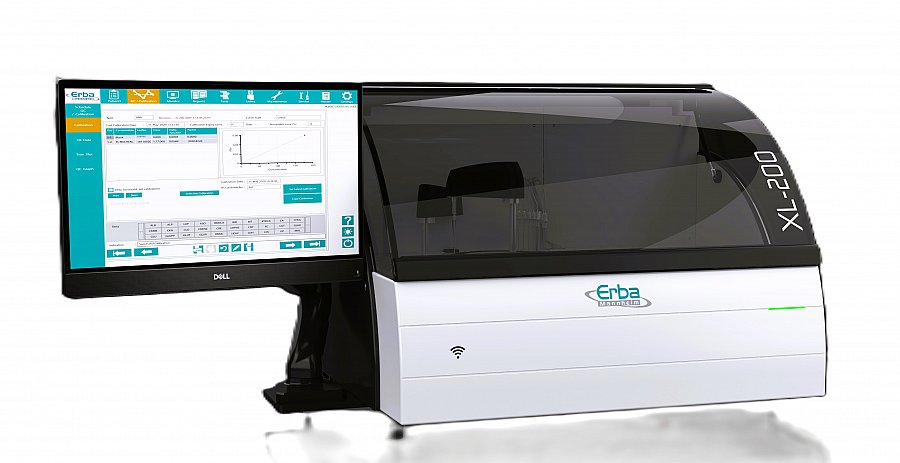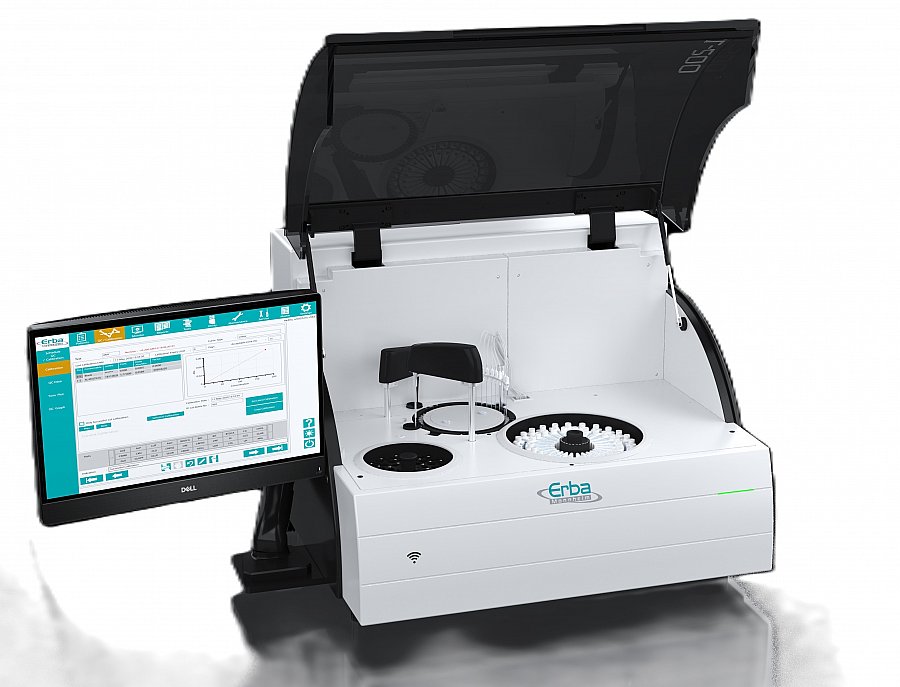


Biochemical analyzer XL 200
Last update: 06.09.2026, 23:31:16

Automatic biochemistry analyser with selective method selection
This is a modern bench-top analyser using a filter-based system with highly economical operation. The instrument features a comprehensive quality control program and is also very easy to operate. The ERBA XL 200 performs up to 200 tests per hour and up to 400 tests per hour with ISE (Na/K/Cl/Li), and uses glass cuvettes with a working volume of 180 µl.
-
Compact bench-top design
-
Easy operation
-
Open system
-
Dispensing probes with anti-collision protection and liquid level detection
-
Direct measurement of Na/K/Cl/Li
-
Automatic dilution and automatic repeat analysis
-
Bidirectional connectivity
-
30 sample positions
-
STAT sample loading
-
Ability to use 5, 7 and 10 ml primary tubes and sample cups
-
50 refrigerated reagent positions
-
20 and 50 ml reaction vessels
-
Online reagent status management
-
Multiple reagent positions
-
Integrated washing station for improved accuracy and trueness
-
45 long-life glass cuvettes, individually replaceable
Automatic sample and reagent pipetting
XL-200 features automatic sample and reagent pipetting using a dispensing arm, ensuring accurate handling of liquid volumes from 2 µl to 300 µl in 0.2 µl increments. The dispensing probe with a liquid level sensor ensures the presence of an adequate volume of liquid in the vessel. Anti-collision protection increases the service life of the dispensing system.
Smart mixing
Under-the-surface mixing with three user-selectable mixing speeds ensures thorough mixing of the reaction mixture. This ensures the correct performance of immunoturbidimetric assays. A separate cleaning station guarantees high accuracy.
Smart saving
Reagent savings are enabled by a reagent volume as low as 180 µl. In addition, the analyser uses hardened glass cuvettes.
Quality control with Westgard rules
XL-200 offers a comprehensive quality control program that ensures reliable results through the use of Levey-Jennings charts and Westgard rules. Different quality control levels can be used on XL-200. Marking the acceptability of results using Westgard rules ensures the correct reporting of each individual run.
Washing station
The eight-step washing station ensures complete washing and drying. The reaction mixture containing hazardous substances is removed from the cuvette and transferred to a hazardous waste container. Cleaning is performed using deionised water. The cuvettes are automatically checked for cleanliness and sent for drying, which is performed in two stages and includes a cuvette validation step.
Flexible sample rotor
Provides convenient loading of samples in 5, 7 and 10 ml primary tubes and in sample cups. Any of the 39 positions can be used for a sample, blank, calibrator, control or STAT sample. A barcode reader (not included in the standard configuration) simplifies operation and increases operator productivity.
Reagent rotor
Contains 50 refrigerated positions for containers from the system packaging. 50 or 20 ml containers, or a 5 ml adapter, can be selected. A barcode reader (not included in the standard configuration) simplifies operation and increases operator productivity.
Calibration
Up to 10 standards can be used for immunoturbidimetric measurements. The calibration graph provides information on the calibration curve and calibration time.
Time course
The reaction in the cuvette is monitored throughout the entire reaction period. The reaction curve can be monitored online. Each reaction curve is stored in the memory together with details of absorbance at the primary and secondary wavelengths. Assay parameters (calibration) can be changed even after the analysis has been performed; results are automatically recalculated using the new data, for example with a different calibration curve shape.
Technical data
Throughput: 200 photometric tests per hour without ISE and 400 tests per hour with ISE
System: Automatic, open, selective biochemistry analyser with priority for patient samples
Tests on board: Maximum 50 items + 4 ISE
Sample types: Serum, plasma, urine and others
Programmable parameters: Unlimited
Analytical methods: One-point, two-point, rate-A, rate-B, direct potentiometry
Calibration: Linear, non-linear, multi-point
Photometer: Stationary
Absorbance range: 0–2.5
Light source: Halogen lamp
Optics: 8 filters (340–700 nm): 340, 405, 450, 505, 546, 570, 630 and 660 nm
Detector: 8 silicon photodiodes
Sample disc: 30 positions for routine samples, 9 positions for blanks, controls, standards and ISE. All positions can be used for STAT samples.
Reagent rotor: 50 refrigerated positions
Quality control: Program for Levey-Jennings charts and Westgard rules
Reaction rotor: 45 hardened glass cuvettes
Reaction mixture mixing: Mixer with variable mixing speed
Working volume: 180 µl
Washing station: Six-step washing and two-step drying with cuvette cleanliness control
Sample pipetting: 2–70 µl, in 0.2 µl increments
Reagent pipetting: 10–300 µl, in 1 µl increments
System: Compatible with IBM PC, Windows OS, Pentium 4, 1 GB RAM, 80 GB HDD, laser printer, LCD monitor, speakers, USB 2.0 interface
Power supply: AC 220 V ±10%, 50 Hz, 600 VA
Dimensions: 810 mm (W), 800 mm (D), 600 mm (H)